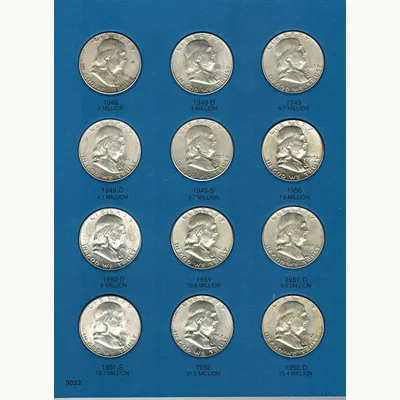
Obverse
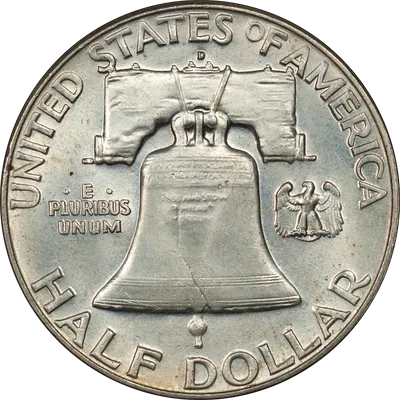
Reverse
1952-D Franklin Half Dollar
$14 – $730
The Franklin Half Dollar - 1952-D was minted at the Denver Mint with a mintage of 25,395,600. Values range from $14 in lower grades to $730 in top condition. The coin contains 90% silver with a melt value of $11.03.
Melt Value (90% silver)
$11.03
Based on $30.50/oz silver
as of Aug 1, 2026
Market Activity
2 recent salesCoinValueDB Price Guide by Grade
| Grade | Value |
|---|---|
Good (G-4)
| $14 |
Very Good (VG-8)
| $17 |
Fine (F-12)
| $28 |
Very Fine (VF-20)
| $19 |
Extremely Fine (EF-40)
| $30 |
About Uncirculated (AU-50)
| $24 |
Choice AU (AU-55)
| $38 |
Mint State (MS-60)
| $36 |
Select (MS-62)
| $42 |
Choice (MS-63)
| $43 |
Near Gem (MS-64)
| $46 |
Gem (MS-65)
Best Value
| $95 |
Superb Gem (MS-66)
| $300 |
Superb Gem+ (MS-67)
| $730 |
Coin Specifications
Historical Notes
1952-D Franklin Half Dollar from Denver Mint.
About the Franklin Half Dollar
The United States Mint produced the Franklin Half Dollar from 1948 through 1963. Mint Director Nellie Tayloe Ross commissioned Chief Engraver John R. Sinnock to design the coin. Sinnock used his previous work on the Sesquicentennial of American Independence half dollar as the model for the portrait of Benjamin Franklin. The reverse features the Liberty Bell and a small eagle, which Congress required by law. The Mint replaced the eagle with a small star to balance the design after the Commission of Fine Arts criticized the original layout. Production of the Franklin Half Dollar ended abruptly in 1963. President John F. Kennedy died in November of that year, and Congress passed legislation to replace the Franklin design with a portrait of Kennedy. The Mint struck the final Franklin halves in 1963, only 16 years after the series began. The coin contains 90% silver and 10% copper, making it a common target for silver melters in later decades.
Collecting Franklin Half Dollar Coins
Focus your search on the Full Bell Lines designation, which requires the horizontal lines on the bottom of the Liberty Bell to show complete detail without weakness. You should start your collection with common dates like 1957, 1958, or 1959, which are easy to find in uncirculated condition for under $30. Avoid coins with heavy bag marks on Franklin's cheek or the bell, as these flaws lower the grade significantly. Watch for coins with artificial toning, as some sellers treat these pieces to hide surface scratches or improper cleaning.
This series includes key dates — check individual coin pages for rarity details.
Frequently Asked Questions
What is a Franklin Half Dollar - 1952-D worth? +
How many 1952 Franklin Half Dollar coins were made? +
Is the Franklin Half Dollar - 1952-D a key date? +
What is the melt value of a Franklin Half Dollar - 1952-D? +
How much is a 1952-D Franklin Half Dollar worth? +
Is the 1952-D Franklin Half Dollar rare? +
Related Guides
Related Franklin Half Dollar Coins
Franklin Half Dollar - 1948
Philadelphia
$21 – $1,125
Franklin Half Dollar - 1949-S
San Francisco
$62 – $3,150
Franklin Half Dollar - 1950
Philadelphia
$14 – $700
Franklin Half Dollar - 1951
Philadelphia
$15 – $670
Franklin Half Dollar - 1953-S
San Francisco
$53 – $3,025
Franklin Half Dollar - 1954
Philadelphia
$14 – $700
Franklin Half Dollar - 1955
Philadelphia
$19 – $1,050
Franklin Half Dollar - 1956
Philadelphia
$16 – $760
Have a half dollar? Scan it now.
Get instant identification, condition grading, and market value.
Scan Now — It's Free